


Years of
COMBINED EXPERIENCE
We have the know-how you need.
The power of international education.
01
CORE
A multidisciplinary aggregator of open access research, it allows users to search more than 66 million open access articles. While most of these link to the full-text article on the original publisher's site, five million records are hosted directly on CORE. In addition to a straightforward keyword search, CORE offers advanced search options to filter results by publication type, year, language, journal, repository, and author.
02
SCIENCE OPEN
Functioning as a research and publishing network, ScienceOpen offers open access to more than 28 million articles in all areas of science. Although you do need to register to view the full text of the articles, registration is free. The advanced search function is highly detailed, allowing you to find precisely the research you're looking for. The goal is to facilitate open and public communications between academics and to allow ideas to be judged on their merit, regardless of where they come from.
03
Doaj
A multidisciplinary, community-curated directory, the Directory of Open Access Journals (DOAJ) gives researchers access to high-quality, peer-reviewed journals. It has archived more than two million articles from 9,519 journals, allowing you to either browse by subject or search by keyword. The aim is to increase the visibility of open access scholarly journals. Content on the site covers subjects from science to law to fine arts and everything in between.
04
ERIC
The Education Resources Information Center (ERIC), of the Institution of Education Sciences, allows you to search by topic for material related to the field of education. Links lead to other sites, where you may have to purchase the information, but you can search for full-text articles only. The service primarily indexes journals, grey literature (such as technical reports, white papers, and government documents), and books. All sources of material on ERIC go through a formal review process prior to being indexed.
05
OPEN DOAR
OpenDOAR, or the Directory of Open Access Repositories, is a comprehensive resource for finding open access journals and articles. Using Google Custom Search, it combs through open access repositories around the world and returns relevant research in all disciplines. The repositories it searches through are assessed and categorized to ensure they meet quality standards.
06
CIA
The CIA World Factbook is a little different from the other resources on this list in that it is not an online journal directory or repository. It is, however, a highly useful research database for academics in a variety of disciplines. All the information is free to access, and it provides facts about every country in the world, including information about history, geography, transportation, and much more.
.jpg)
Research and education aren't just about learning maths or science at school. It’s about gaining the knowledge and the skills needed to better ourselves and the world we live in.
Education helps us become better versions of ourselves
The quotes below remind us that education is a lifelong process of empowerment. Education helps us to grow and develop as individuals. Education can empower us to become empathic individuals, build our self-confidence and learn more about our strengths.
“The more that you read, the more things you will know, the more that you learn, the more places you’ll go.”—Dr. Seuss
“Education is one thing no one can take away from you.”—Elin Nordegren
“Education breeds confidence. Confidence breeds hope. Hope breeds peace.”—Confucius
“Education is the key that unlocks the golden door to freedom.”—George Washington Carver
“Give a man a fish and you feed him for a day; teach a man to fish and you feed him for a lifetime.”—Maimonides
Education enhances our perspective on the world
Enriching our brains with new and valuable information improves our ability to think, analyze, and process the world around us. Education is important because it broadens our knowledge, and this knowledge then opens our minds to new perspectives, ideas, beliefs, and cultures.
Being presented with different perspectives on the world helps us quickly adapt to new and unfamiliar environments. It also teaches us to stay calm when faced with problems, and it gives us techniques to deal with challenges in a logical way.
The quotes below encourage us to think about our own perspectives on the world we live in.
“Education’s purpose is to replace an empty mind with an open one.”—Malcolm Forbes
“Education is what remains after one has forgotten what one has learned in school.”—Albert Einstein
“Education is not preparation for life; education is life itself.”—John Dewey
“The aim of education is the knowledge, not of facts, but of values.”—William S. Burroughs
"What makes a child gifted and talented may not always be good grades in school, but a different way of looking at the world and learning."—Chuck Grassley
Education helps us become better people
Education goes beyond shaping us as individuals and enhancing our perspectives—it helps us better handle problematic situations. It can also help us form opinions on world issues and teach us about the larger community.
With educated opinions, we can support each other and make decisions that help establish a positive change in our communities. These quotes inspire us to reflect on how education can help us contribute more to our communities.
“Education is the vaccine of violence.”—Edward James Olmos
“Learning is not compulsory… Neither is survival”—W. Edwards Demin
“The purpose of education is to turn mirrors into windows.”—Sydney J. Harris
“Intelligence plus character-that is the goal of true education.”—Martin Luther King Jr.
“Education is the most powerful weapon which you can use to change the world.”—Nelson Mandela
Education can create innovative leaders
The children of today are the future of tomorrow. And in order to tackle the environmental, social, and economic issues that our societies will face in the future, we need educated, skilled leaders who are dedicated to pursuing creative solutions. The quotes below remind us that education today is an investment we are making for tomorrow.
Use this template
“The ability to read, write, and analyze; the confidence to stand up and demand justice and equality; the qualifications and connections to get your foot in the door and take your seat at the table—all of that starts with education.”—Michelle Obama
“A child without education is like a bird without wings.”—Tibetan Proverb
“The purpose of learning is growth, and our minds, unlike our bodies, can continue growing as we continue to live.”—Mortimer Adler
“The principal goal of education in the schools should be creating men and women who are capable of doing new things, not simply repeating what other generations have done.”—Jean Piaget
“The content of a book holds the power of education and it is with this power that we can shape our future and change lives.”—Malala Yousafzai
Education empowers people
Education can empower us as individuals with the values, skills, and knowledge we need to provide valuable solutions to global issues. The quotes below emphasize how education empowers the individual so that they can better the world around them.
“Education makes a people easy to lead but difficult to drive: easy to govern, but impossible to enslave.”—Peter Brougham
“The goal of education is the advancement of knowledge and the dissemination of truth.”—John F. Kennedy
“Knowledge is power. Information is liberating. Education is the premise of progress, in every society, in every family.”—Kofi Annan
“Education is the passport to the future, for tomorrow belongs to those who prepare for it today.”—Malcolm X
“Whatever the cost of our libraries, the price is cheap compared to that of an ignorant nation.”―Walter Cronkite

Freedom of speech
"Free speech" and "Freedom of expression" redirect here. For free speech restrictions on Wikipedia, see Wikipedia:Free speech. For the Eddie Harris album, see Free Speech (album). For other uses, see Freedom of expression (disambiguation) and Freedom of speech (disambiguation).
Eleanor Roosevelt and the Universal Declaration of Human Rights (1948)—Article 19 states that "Everyonehas the right to freedom of opinion and expression; this right includes freedom to hold opinions without interference and to seek, receive and impart information and ideas through any media and regardless of frontiers".[1]
Freedom of speech[2] is a principle that supports the freedom of an individual or a community to articulate their opinions and ideas without fear of retaliation, censorship, or legal sanction. The term freedom of expression is usually used synonymously but, in legal sense, includes any activity of seeking, receiving, and imparting information or ideas, regardless of the medium used.
The right to freedom of expression is recognized as a human right under article 19 of the Universal Declaration of Human Rights (UDHR) and recognized in international human rights law in the International Covenant on Civil and Political Rights (ICCPR). Article 19 of the UDHR states that "everyone shall have the right to hold opinions without interference" and "everyone shall have the right to freedom of expression; this right shall include freedom to seek, receive and impart information and ideas of all kinds, regardless of frontiers, either orally, in writing or in print, in the form of art, or through any other media of his choice". The version of Article 19 in the ICCPR later amends this by stating that the exercise of these rights carries "special duties and responsibilities" and may "therefore be subject to certain restrictions" when necessary "[f]or respect of the rights or reputation of others" or "[f]or the protection of national security or of public order (order public), or of public health or morals".[3]
Freedom of speech and expression, therefore, may not be recognized as being absolute, and common limitations or boundaries to freedom of speech relate to libel, slander, obscenity, pornography, sedition, incitement, fighting words, classified information, copyright violation, trade secrets, food labeling, non-disclosure agreements, the right to privacy, dignity, the right to be forgotten, public security, and perjury. Justifications for such include the harm principle, proposed by John Stuart Mill in On Liberty, which suggests that "the only purpose for which power can be rightfully exercised over any member of a civilized community, against his will, is to prevent harm to others."[4]
The idea of the "offense principle" is also used in the justification of speech limitations, describing the restriction on forms of expression deemed offensive to society, considering factors such as extent, duration, motives of the speaker, and ease with which it could be avoided.[4] With the evolution of the digital age, application of freedom of speech becomes more controversial as new means of communication and restrictions arise, for example the Golden Shield Project, an initiative by Chinese government's Ministry of Public Security that filters potentially unfavourable data from foreign countries.
Contents
Origins
Freedom of speech and expression has a long history that predates modern international human rights instruments.[5] It is thought that the ancient Athenian democratic principle of free speech may have emerged in the late 6th or early 5th century BC.[6] The values of the Roman Republic included freedom of speech and freedom of religion.[7]
Concepts of freedom of speech can be found in early human rights documents.[5] England's Bill of Rights 1689 legally established the constitutional right of freedom of speech in Parliament which is still in effect.[8][9]
One of the world's first freedom of the press acts was introduced in Sweden in 1766, mainly due to classical liberal member of parliament, Ostrobothnian priest, Anders Chydenius.[10][11][12][13] Excepted and liable to prosecution was only vocal opposition to the King and the Church of Sweden.
The Declaration of the Rights of Man and of the Citizen, adopted during the French Revolution in 1789, specifically affirmed freedom of speech as an inalienable right.[5] Adopted in 1791, freedom of speech is a feature of the First Amendment to the United States Constitution.[14] The French Declaration provides for freedom of expression in Article 11, which states that:
The free communication of ideas and opinions is one of the most precious of the rights of man. Every citizen may, accordingly, speak, write, and print with freedom, but shall be responsible for such abuses of this freedom as shall be defined by law.[15]
Article 19 of the Universal Declaration of Human Rights, adopted in 1948, states that:
Everyone has the right to freedom of opinion and expression; this right includes freedom to hold opinions without interference and to seek, receive and impart information and ideas through any media and regardless of frontiers.[16]
Today, freedom of speech, or the freedom of expression, is recognised in international and regional human rights law. The right is enshrined in Article 19 of the International Covenant on Civil and Political Rights, Article 10 of the European Convention on Human Rights, Article 13 of the American Convention on Human Rights and Article 9 of the African Charter on Human and Peoples' Rights.[17] Based on John Milton's arguments, freedom of speech is understood as a multi-faceted right that includes not only the right to express, or disseminate, information and ideas, but three further distinct aspects:
-
the right to seek information and ideas;
-
the right to receive information and ideas;
-
the right to impart information and ideas
International, regional and national standards also recognise that freedom of speech, as the freedom of expression, includes any medium, whether it be orally, in written, in print, through the Internet or through art forms. This means that the protection of freedom of speech as a right includes not only the content, but also the means of expression.[17]
Relationship to other rights
The right to freedom of speech and expression is closely related to other rights, and may be limited when conflicting with other rights (see limitations on freedom of speech).[17] The right to freedom of expression is also related to the right to a fair trial and court proceeding which may limit access to the search for information, or determine the opportunity and means in which freedom of expression is manifested within court proceedings.[18] As a general principle freedom of expression may not limit the right to privacy, as well as the honor and reputation of others. However greater latitude is given when criticism of public figures is involved.[18]
The right to freedom of expression is particularly important for media, which plays a special role as the bearer of the general right to freedom of expression for all.[17] However, freedom of the press does not necessarily enable freedom of speech. Judith Lichtenberg has outlined conditions in which freedom of the press may constrain freedom of speech, for example where the media suppresses information or stifles the diversity of voices inherent in freedom of speech. Lichtenberg argues that freedom of the press is simply a form of property right summed up by the principle "no money, no voice".[19]
Democracy and social interaction
Freedom of speech is understood to be fundamental in a democracy. The norms on limiting freedom of expression mean that public debate may not be completely suppressed even in times of emergency.[18] One of the most notable proponents of the link between freedom of speech and democracy is Alexander Meiklejohn. He has argued that the concept of democracy is that of self-government by the people. For such a system to work, an informed electorate is necessary. In order to be appropriately knowledgeable, there must be no constraints on the free flow of information and ideas. According to Meiklejohn, democracy will not be true to its essential ideal if those in power are able to manipulate the electorate by withholding information and stifling criticism. Meiklejohn acknowledges that the desire to manipulate opinion can stem from the motive of seeking to benefit society. However, he argues, choosing manipulation negates, in its means, the democratic ideal.[20]
Eric Barendt has called this defence of free speech on the grounds of democracy "probably the most attractive and certainly the most fashionable free speech theory in modern Western democracies".[21] Thomas I. Emerson expanded on this defence when he argued that freedom of speech helps to provide a balance between stability and change. Freedom of speech acts as a "safety valve" to let off steam when people might otherwise be bent on revolution. He argues that "The principle of open discussion is a method of achieving a more adaptable and at the same time more stable community, of maintaining the precarious balance between healthy cleavage and necessary consensus." Emerson furthermore maintains that "Opposition serves a vital social function in offsetting or ameliorating (the) normal process of bureaucratic decay."[22]
Research undertaken by the Worldwide Governance Indicators project at the World Bank, indicates that freedom of speech, and the process of accountability that follows it, have a significant impact in the quality of governance of a country. "Voice and Accountability" within a country, defined as "the extent to which a country's citizens are able to participate in selecting their government, as well as freedom of expression, freedom of association, and free media" is one of the six dimensions of governance that the Worldwide Governance Indicators measure for more than 200 countries.[23] Against this backdrop it is important that development agencies create grounds for effective support for a free press in developing countries.[24]
Richard Moon has developed the argument that the value of freedom of speech and freedom of expression lies with social interactions. Moon writes that "by communicating an individual forms relationships and associations with others – family, friends, co-workers, church congregation, and countrymen. By entering into discussion with others an individual participates in the development of knowledge and in the direction of the community."[25]
Limitations
For specific country examples, see Freedom of speech by country and criminal speech.
Members of Westboro Baptist Church (pictured in 2006) have been specifically banned from entering Canada for hate speech.[26]
Freedom of speech is not an absolute right, and legal systems generally set limits on the freedom of speech, particularly when freedom of speech conflicts with other rights and protections, such as in the cases of libel, slander, pornography, obscenity, fighting words, and intellectual property.
In some countries, blasphemy is a crime. For example, in Austria, defaming Muhammad the Prophet of Islam is not protected as free speech.[27][28][29] In contrast, in France, blasphemy and disparagement of the Prophet Muhammad are protected under free speech law.
Justifications for limitations to freedom of speech often reference the "harm principle" or the "offence principle". Limitations to freedom of speech may occur through legal sanction or social disapprobation, or both.[30] Certain public institutions may also enact policies restricting the freedom of speech, for example speech codes at state schools.
In On Liberty (1859), John Stuart Mill argued that "...there ought to exist the fullest liberty of professing and discussing, as a matter of ethical conviction, any doctrine, however immoral it may be considered."[30] Mill argues that the fullest liberty of expression is required to push arguments to their logical limits, rather than the limits of social embarrassment.[31][32][33][34]
In 1985, Joel Feinberg introduced what is known as the "offence principle". Feinberg wrote "It is always a good reason in support of a proposed criminal prohibition that it would probably be an effective way of preventing serious offence (as opposed to injury or harm) to persons other than the actor, and that it is probably a necessary means to that end."[35] Hence Feinberg argues that the harm principle sets the bar too high and that some forms of expression can be legitimately prohibited by law because they are very offensive. But, as offending someone is less serious than harming someone, the penalties imposed should be higher for causing harm.[35] In contrast, Mill does not support legal penalties unless they are based on the harm principle.[30] Because the degree to which people may take offence varies, or may be the result of unjustified prejudice, Feinberg suggests that a number of factors need to be taken into account when applying the offence principle, including: the extent, duration and social value of the speech, the ease with which it can be avoided, the motives of the speaker, the number of people offended, the intensity of the offence, and the general interest of the community at large.[30]
Jasper Doomen argued that harm should be defined from the point of view of the individual citizen, not limiting harm to physical harm since nonphysical harm may also be involved; Feinberg's distinction between harm and offence is criticized as largely trivial.[36]
In 1999, Bernard Harcourt wrote of the collapse of the harm principle: "Today the debate is characterized by a cacophony of competing harm arguments without any way to resolve them. There is no longer an argument within the structure of the debate to resolve the competing claims of harm. The original harm principle was never equipped to determine the relative importance of harms."[37]
Interpretations of both the harm and offense limitations to freedom of speech are culturally and politically relative. For instance, in Russia, the harm and offense principles have been used to justify the Russian LGBT propaganda law restricting speech (and action) in relation to LGBT issues. A number of European countries that take pride in freedom of speech nevertheless outlaw speech that might be interpreted as Holocaust denial. These include Austria, Belgium, Canada, the Czech Republic, France, Germany, Hungary, Israel, Liechtenstein, Lithuania, Luxembourg, Netherlands, Poland, Portugal, Russia, Slovakia, Switzerland and Romania.[38]
Armenian Genocide denial is also illegal in some countries.
In the U.S., the standing landmark opinion on political speech is Brandenburg v. Ohio (1969),[39] expressly overruling Whitney v. California.[40] In Brandenburg, the US Supreme Court referred to the right even to speak openly of violent action and revolution in broad terms:
[Our] decisions have fashioned the principle that the constitutional guarantees of free speech and free press do not allow a State to forbid or proscribe advocacy of the use of force or law violation except where such advocacy is directed to inciting or producing imminent lawless action and is likely to incite or cause such action.[41]
The opinion in Brandenburg discarded the previous test of "clear and present danger" and made the right to freedom of (political) speech protections in the United States almost absolute.[42][43] Hate speech is also protected by the First Amendment in the United States, as decided in R.A.V. v. City of St. Paul, (1992) in which the Supreme Court ruled that hate speech is permissible, except in the case of imminent violence.[44] See the First Amendment to the United States Constitution for more detailed information on this decision and its historical background.
The Internet and information society
The Free Speech Flag was created during the AACS encryption key controversy as "a symbol to show support for personal freedoms."[45]
Jo Glanville, editor of the Index on Censorship, states that "the Internet has been a revolution for censorship as much as for free speech".[46] International, national and regional standards recognise that freedom of speech, as one form of freedom of expression, applies to any medium, including the Internet.[17] The Communications Decency Act (CDA) of 1996 was the first major attempt by the United States Congress to regulate pornographic material on the Internet. In 1997, in the landmark cyberlaw case of Reno v. ACLU, the US Supreme Court partially overturned the law.[47] Judge Stewart R. Dalzell, one of the three federal judges who in June 1996 declared parts of the CDA unconstitutional, in his opinion stated the following:[48]
The Internet is a far more speech-enhancing medium than print, the village green, or the mails. Because it would necessarily affect the Internet itself, the CDA would necessarily reduce the speech available for adults on the medium. This is a constitutionally intolerable result. Some of the dialogue on the Internet surely tests the limits of conventional discourse. Speech on the Internet can be unfiltered, unpolished, and unconventional, even emotionally charged, sexually explicit, and vulgar – in a word, "indecent" in many communities. But we should expect such speech to occur in a medium in which citizens from all walks of life have a voice. We should also protect the autonomy that such a medium confers to ordinary people as well as media magnates.[...] My analysis does not deprive the Government of all means of protecting children from the dangers of Internet communication. The Government can continue to protect children from pornography on the Internet through vigorous enforcement of existing laws criminalising obscenity and child pornography. [...] As we learned at the hearing, there is also a compelling need for public educations about the benefits and dangers of this new medium, and the Government can fill that role as well. In my view, our action today should only mean that Government's permissible supervision of Internet contents stops at the traditional line of unprotected speech. [...] The absence of governmental regulation of Internet content has unquestionably produced a kind of chaos, but as one of the plaintiff's experts put it with such resonance at the hearing: "What achieved success was the very chaos that the Internet is. The strength of the Internet is chaos." Just as the strength of the Internet is chaos, so that strength of our liberty depends upon the chaos and cacophony of the unfettered speech the First Amendment protects.[48]
The World Summit on the Information Society (WSIS) Declaration of Principles adopted in 2003 makes specific reference to the importance of the right to freedom of expression for the "Information Society" in stating:
We reaffirm, as an essential foundation of the Information society, and as outlined in Article 19 of the Universal Declaration of Human Rights, that everyone has the right to freedom of opinion and expression; that this right includes freedom to hold opinions without interference and to seek, receive and impart information and ideas through any media and regardless of frontiers. Communication is a fundamental social process, a basic human need and the foundation of all social organisation. It is central to the Information Society. Everyone, everywhere should have the opportunity to participate and no one should be excluded from the benefits of the Information Society offers.[49]
According to Bernt Hugenholtz and Lucie Guibault the public domain is under pressure from the "commodification of information" as information with previously little or no economic value has acquired independent economic value in the information age. This includes factual data, personal data, genetic information and pure ideas. The commodification of information is taking place through intellectual property law, contract law, as well as broadcasting and telecommunications law.[50]
Freedom of information
Freedom of information is an extension of freedom of speech where the medium of expression is the Internet. Freedom of information may also refer to the right to privacy in the context of the Internet and information technology. As with the right to freedom of expression, the right to privacy is a recognised human right and freedom of information acts as an extension to this right.[51] Freedom of information may also concern censorship in an information technology context, i.e. the ability to access Web content, without censorship or restrictions.[52]
Freedom of information is also explicitly protected by acts such as the Freedom of Information and Protection of Privacy Act of Ontario, in Canada. The Access to Information Act gives Canadian citizens, permanent residents, and any person or corporation present in Canada a right to access records of government institutions that are subject to the Act. [53]
Internet censorship
The concept of freedom of information has emerged in response to state sponsored censorship, monitoring and surveillance of the internet. Internet censorship includes the control or suppression of the publishing or accessing of information on the Internet.[54] The Global Internet Freedom Consortium claims to remove blocks to the "free flow of information" for what they term "closed societies".[55] According to the Reporters without Borders (RWB) "internet enemy list" the following states engage in pervasive internet censorship: China, Cuba, Iran, Myanmar/Burma, North Korea, Saudi Arabia, Syria, Turkmenistan, Uzbekistan, and Vietnam.[56]
A widely publicized example of internet censorship is the "Great Firewall of China" (in reference both to its role as a network firewall and to the ancient Great Wall of China). The system blocks content by preventing IP addresses from being routed through and consists of standard firewall and proxy servers at the Internet gateways. The system also selectively engages in DNS poisoning when particular sites are requested. The government does not appear to be systematically examining Internet content, as this appears to be technically impractical.[57] Internet censorship in the People's Republic of China is conducted under a wide variety of laws and administrative regulations, including more than sixty regulations directed at the Internet. Censorship systems are vigorously implemented by provincial branches of state-owned ISPs, business companies, and organizations.[58][59]
Challenge of disinformation
Some legal scholars (such as Tim Wu of Columbia University) have argued that the traditional issues of free speech -- that "the main threat to free speech" is the censorship of "suppressive states", and that "ill-informed or malevolent speech" can and should be overcome by "more and better speech" rather than censorship -- assumes a scarcity of information. This scarcity prevailed during the 20th century, but with the arrival of the internet, information became plentiful, "but the attention of listeners" scarce. And in the words of Wu, this “cheap speech" made possible by the internet " ... may be used to attack, harass, and silence as much as it is used to illuminate or debate.”[60][61]
In the 21st century, the danger is not "suppressive states" that target "speakers directly", but that
targets listeners or it undermines speakers indirectly. More precisely, emerging techniques of speech control depend on (1) a range of new punishments, like unleashing “troll armies” to abuse the press and other critics, and (2) “flooding” tactics (sometimes called “reverse censorship”) that distort or drown out disfavored speech through the creation and dissemination of fake news, the payment of fake commentators, and the deployment of propaganda robots.[62] As journalist Peter Pomerantsev writes, these techniques employ “information ... in weaponized terms, as a tool to confuse, blackmail, demoralize, subvert and paralyze.”[63][60]
History of dissent and truth
Further information: Dissent
Before the invention of the printing press, a written work, once created, could only be physically multiplied by highly laborious and error-prone manual copying. No elaborate system of censorship and control over scribes existed, who until the 14th century were restricted to religious institutions, and their works rarely caused wider controversy. In response to the printing press, and the theological heresies it allowed to spread, the Roman Catholic Church moved to impose censorship.[64] Printing allowed for multiple exact copies of a work, leading to a more rapid and widespread circulation of ideas and information (see print culture).[65] The origins of copyright law in most European countries lie in efforts by the Roman Catholic Church and governments to regulate and control the output of printers.[65]
In Panegyricae orationes septem (1596), Henric van Cuyck, a Dutch Bishop, defended the need for censorship and argued that Johannes Gutenberg's printing press had resulted in a world infected by "pernicious lies"—so van Cuyck singled out the Talmud and the Qur'an, and the writings of Martin Luther, Jean Calvin and Erasmus of Rotterdam.[66]
In 1501 Pope Alexander VI issued a Bill against the unlicensed printing of books. In 1559 Pope Paul IV promulgated the Index Expurgatorius, or List of Prohibited Books.[64] The Index Expurgatorius is the most famous and long lasting example of "bad books" catalogues issued by the Roman Catholic Church, which presumed to be in authority over private thoughts and opinions, and suppressed views that went against its doctrines. The Index Expurgatorius was administered by the Roman Inquisition, but enforced by local government authorities, and went through 300 editions. Amongst others, it banned or censored books written by René Descartes, Giordano Bruno, Galileo Galilei, David Hume, John Locke, Daniel Defoe, Jean-Jacques Rousseau and Voltaire.[67] While governments and church encouraged printing in many ways because it allowed for the dissemination of Bibles and government information, works of dissent and criticism could also circulate rapidly. As a consequence, governments established controls over printers across Europe, requiring them to have official licenses to trade and produce books.[65]
First page of John Milton's 1644 edition of Areopagitica, in which he argued forcefully against the Licensing Order of 1643
The notion that the expression of dissent or subversive views should be tolerated, not censured or punished by law, developed alongside the rise of printing and the press. Areopagitica, published in 1644, was John Milton's response to the Parliament of England's re-introduction of government licensing of printers, hence publishers.[68] Church authorities had previously ensured that Milton's essay on the right to divorce was refused a license for publication. In Areopagitica, published without a license,[69] Milton made an impassioned plea for freedom of expression and toleration of falsehood,[68] stating:
Give me the liberty to know, to utter, and to argue freely according to conscience, above all liberties.[68]
This 1688 edition of Jacobus de Voragine's Golden Legend (1260) was censored according to the Index Librorum Expurgatorum of 1707, which listed the specific passages of books already in circulation that required censorship[70][71]
Milton's defense of freedom of expression was grounded in a Protestant worldview and he thought that the English people had the mission to work out the truth of the Reformation, which would lead to the enlightenment of all people. But Milton also articulated the main strands of future discussions about freedom of expression. By defining the scope of freedom of expression and of "harmful" speech Milton argued against the principle of pre-censorship and in favor of tolerance for a wide range of views.[68] Freedom of the press ceased being regulated in England in 1695 when the Licensing Order of 1643 was allowed to expire after the introduction of the Bill of Rights 1689 shortly after the Glorious Revolution.[72][73] The emergence of publications like the Tatler (1709) and the Spectator (1711) are given credit for creating a 'bourgeois public sphere' in England that allowed for a free exchange of ideas and information.
As the "menace" of printing spread, more governments attempted to centralize control.[74] The French crown repressed printing and the printer Etienne Dolet was burned at the stake in 1546. In 1557 the British Crown thought to stem the flow of seditious and heretical books by chartering the Stationers' Company. The right to print was limited to the members of that guild, and thirty years later the Star Chamber was chartered to curtail the "greate enormities and abuses" of "dyvers contentyous and disorderlye persons professinge the arte or mystere of pryntinge or selling of books." The right to print was restricted to two universities and to the 21 existing printers in the city of London, which had 53 printing presses. As the British crown took control of type founding in 1637 printers fled to the Netherlands. Confrontation with authority made printers radical and rebellious, with 800 authors, printers and book dealers being incarcerated in the Bastille in Paris before it was stormed in 1789.[74]
A succession of English thinkers was at the forefront of early discussion on a right to freedom of expression, among them John Milton (1608–74) and John Locke (1632–1704). Locke established the individual as the unit of value and the bearer of rights to life, liberty, property and the pursuit of happiness. However Locke's ideas evolved primarily around the concept of the right to seek salvation for one's soul, and was thus primarily concerned with theological matters. Locke neither supported a universal toleration of peoples nor freedom of speech; according to his ideas, some groups, such as atheists, should not be allowed.[75]
George Orwell statue at the headquarters of the BBC. A defence of free speech in an open society, the wall behind the statue is inscribed with the words "If liberty means anything at all, it means the right to tell people what they do not want to hear”, words from George Orwell's proposed preface to Animal Farm (1945).[76]
By the second half of the 17th century philosophers on the European continent like Baruch Spinoza and Pierre Bayle developed ideas encompassing a more universal aspect freedom of speech and toleration than the early English philosophers.[75] By the 18th century the idea of freedom of speech was being discussed by thinkers all over the Western world, especially by French philosophes like Denis Diderot, Baron d'Holbach and Claude Adrien Helvétius.[77] The idea began to be incorporated in political theory both in theory as well as practice; the first state edict in history proclaiming complete freedom of speech was the one issued December 4, 1770 in Denmark-Norway during the regency of Johann Friedrich Struensee.[78] However Struensee himself imposed some minor limitations to this edict on October 7, 1771, and it was even further limited after the fall of Struensee with legislation introduced in 1773, although censorship was not reintroduced.[79]
John Stuart Mill (1806–1873) argued that without human freedom there can be no progress in science, law or politics, which according to Mill required free discussion of opinion. Mill's On Liberty, published in 1859 became a classic defence of the right to freedom of expression.[68] Mill argued that truth drives out falsity, therefore the free expression of ideas, true or false, should not be feared. Truth is not stable or fixed, but evolves with time. Mill argued that much of what we once considered true has turned out false. Therefore, views should not be prohibited for their apparent falsity. Mill also argued that free discussion is necessary to prevent the "deep slumber of a decided opinion". Discussion would drive the onwards march of truth and by considering false views the basis of true views could be re-affirmed.[80] Furthermore, Mill argued that an opinion only carries intrinsic value to the owner of that opinion, thus silencing the expression of that opinion is an injustice to a basic human right. For Mill, the only instance in which speech can be justifiably suppressed is in order to prevent harm from a clear and direct threat. Neither economic or moral implications, nor the speakers own well-being would justify suppression of speech.[81]
In her biography of Voltaire, Evelyn Beatrice Hall coined the following sentence to illustrate Voltaire's beliefs: "I disapprove of what you say, but I will defend to the death your right to say it."[82] Hall's quote is frequently cited to describe the principle of freedom of speech.[82] In the 20th Century, Noam Chomsky stated, "If you believe in freedom of speech, you believe in freedom of speech for views you don't like. Dictators such as Stalin and Hitler, were in favor of freedom of speech for views they liked only. If you're in favor of freedom of speech, that means you're in favor of freedom of speech precisely for views you despise."[83] Lee Bollinger argues that "the free speech principle involves a special act of carving out one area of social interaction for extraordinary self-restraint, the purpose of which is to develop and demonstrate a social capacity to control feelings evoked by a host of social encounters." Bollinger argues that tolerance is a desirable value, if not essential. However, critics argue that society should be concerned by those who directly deny or advocate, for example, genocide (see limitations above).[84]
An "unexpurgated" edition of Lady Chatterley's Lover (1959)
The 1928 novel Lady Chatterley's Lover by D. H. Lawrence was banned for obscenity in a number of countries, including the United Kingdom, the United States, Australia and Canada. In the late 1950s and early 1960s, it was the subject of landmark court rulings which saw the ban for obscenity overturned. Dominic Sandbrook of The Telegraph in the UK wrote, "Now that public obscenity has become commonplace, it is hard to recapture the atmosphere of a society that saw fit to ban books such as Lady Chatterley's Lover because it was likely to “deprave and corrupt” its readers."[85] Fred Kaplan of The New York Times stated the overturning of the obscenity laws "set off an explosion of free speech" in the U.S.[86] The 1960s also saw the Free Speech Movement, a massive long-lasting student protest on the campus of the University of California, Berkeley during the 1964–65 academic year.[87]
In 1964 comedian Lenny Bruce was arrested in the U.S. due to complaints again pertaining to his use of various obscenities. A three-judge panel presided over his widely publicized six-month trial in which he was found guilty of obscenity in November 1964. He was sentenced on December 21, 1964, to four months in a workhouse.[88] He was set free on bail during the appeals process and died before the appeal was decided. On December 23, 2003, thirty-seven years after Bruce's death, New York Governor George Pataki granted him a posthumous pardon for his obscenity conviction.[89]
In the United States, the right to freedom of expression has been interpreted to include the right to take and publish photographs of strangers in public areas without their permission or knowledge.[90][91] This is not the case worldwide.
Freedom of speech on college campuses
In July 2014, the University of Chicago released the "Chicago Statement", a free speech policy statement designed to combat censorship on campus. This statement was later adopted by a number of top-ranked universities including Princeton University, Washington University in St. Louis, Johns Hopkins University, and Columbia University.[92][93]
Commentators such as Vox's Zack Beauchamp and Chris Quintana, writing in The Chronicle of Higher Education, have disputed the assumption that college campuses are facing a "free-speech crisis".
Freedom of Speech Quotes
“If liberty means anything at all, it means the right to tell people what they do not want to hear.”
― George Orwell
“I disapprove of what you say, but I will defend to the death your right to say it.”
― S.G. Tallentyre, The Friends of Voltaire
“I may not agree with you, but I will defend to the death your right to make an ass of yourself.”
― Oscar Wilde
“Censorship is to art as lynching is to justice.”
― Henry Louis Gates Jr
“To announce that there must be no criticism of the President, or that we are to stand by the President, right or wrong, is not only unpatriotic and servile, but is morally treasonable to the American public.”
― Theodore Roosevelt
“If freedom of speech is taken away, then dumb and silent we may be led, like sheep to the slaughter.”
― George Washington
“Once a government is committed to the principle of silencing the voice of opposition, it has only one way to go, and that is down the path of increasingly repressive measures, until it becomes a source of terror to all its citizens and creates a country where everyone lives in fear."
[Special Message to the Congress on the Internal Security of the United States, August 8, 1950]”
― Harry S. Truman
“My own opinion is enough for me, and I claim the right to have it defended against any consensus, any majority, anywhere, any place, any time. And anyone who disagrees with this can pick a number, get in line, and kiss my ass.”
― Christopher Hitchens
“Hypocrites get offended by the truth.”
― Jess C. Scott, Bad Romance: Seven Deadly Sins Anthology
“Give me the liberty to know, to utter, and to argue freely according to conscience, above all liberties.”
― John Milton , Areopagitica
“There are more instances of the abridgment of the freedom of the people by gradual and silent encroachments of those in power than by violent and sudden usurpations.”
― James Madison
“Whoever would overthrow the liberty of a nation must begin by subduing the freeness of speech.”
― Benjamin Franklin, Silence Dogood / The Busy-Body / Early Writings
“Everyone has the right to freedom of opinion and expression; this right includes freedom to hold opinions without interference and to seek, receive and impart information and ideas through any media and regardless of frontiers.”
― United Nations, Universal Declaration of Human Rights
“1. Everyone is entitled to their opinion about the things they read (or watch, or listen to, or taste, or whatever). They’re also entitled to express them online.
2. Sometimes those opinions will be ones you don’t like.
3. Sometimes those opinions won’t be very nice.
4. The people expressing those may be (but are not always) assholes.
5. However, if your solution to this “problem” is to vex, annoy, threaten or harrass them, you are almost certainly a bigger asshole.
6. You may also be twelve.
7. You are not responsible for anyone else’s actions or karma, but you are responsible for your own.
8. So leave them alone and go about your own life."
[Bad Reviews: I Can Handle Them, and So Should You (Blog post, July 17, 2012)]”
― John Scalzi
“Proclaim the truth and do not be silent through fear.”
― St. Catherine of Siena
“The problem with today’s world is that everyone believes they have the right to express their opinion AND have others listen to it.
The correct statement of individual rights is that everyone has the right to an opinion, but crucially, that opinion can be roundly ignored and even made fun of, particularly if it is demonstrably nonsense!”
― Brian Cox
“Too many adults wish to 'protect' teenagers when they should be stimulating them to read of life as it is lived.”
― Margaret A. Edwards
“This is slavery, not to speak one's thought.”
― Euripides, The Phoenician Women
“Confidence is knowing who you are and not changing it a bit because of someone’s version of reality is not your reality.”
― Shannon L. Alder
“It was a shocking thing to say and I knew it was a shocking thing to say. But no one has the right to live without being shocked. No one has the right to spend their life without being offended. Nobody has to read this book. Nobody has to pick it up. Nobody has to open it. And if you open it and read it, you don't have to like it. And if you read it and you dislike it, you don't have to remain silent about it. You can write to me, you can complain about it, you can write to the publisher, you can write to the papers, you can write your own book. You can do all those things, but there your rights stop. No one has the right to stop me writing this book. No one has the right to stop it being published, or sold, or bought, or read.”
― Philip Pullman
“Until every soul is freely permitted to investigate every book, and creed, and dogma for itself, the world cannot be free. Mankind will be enslaved until there is mental grandeur enough to allow each man to have his thought and say. This earth will be a paradise when men can, upon all these questions differ, and yet grasp each other's hands as friends. It is amazing to me that a difference of opinion upon subjects that we know nothing with certainty about, should make us hate, persecute, and despise each other. Why a difference of opinion upon predestination, or the trinity, should make people imprison and burn each other seems beyond the comprehension of man; and yet in all countries where Christians have existed, they have destroyed each other to the exact extent of their power. Why should a believer in God hate an atheist? Surely the atheist has not injured God, and surely he is human, capable of joy and pain, and entitled to all the rights of man. Would it not be far better to treat this atheist, at least, as well as he treats us?
Christians tell me that they love their enemies, and yet all I ask is—not that they love their enemies, not that they love their friends even, but that they treat those who differ from them, with simple fairness.
We do not wish to be forgiven, but we wish Christians to so act that we will not have to forgive them. If all will admit that all have an equal right to think, then the question is forever solved; but as long as organized and powerful churches, pretending to hold the keys of heaven and hell, denounce every person as an outcast and criminal who thinks for himself and denies their authority, the world will be filled with hatred and suffering. To hate man and worship God seems to be the sum of all the creeds.”
― Robert G. Ingersoll, Some Mistakes of Moses
“To view the opposition as dangerous is to misunderstand the basic concepts of democracy. To oppress the opposition is to assault the very foundation of democracy.”
― Aung San Suu Kyi, Letters from Burma
“If you're not going to use your free speech to criticize your own government, then what the hell is the point of having it?”
― Michel Templet
“To criticize a person for their race is manifestly irrational and ridiculous, but to criticize their religion, that is a right. That is a freedom. The freedom to criticize ideas, any ideas - even if they are sincerely held beliefs - is one of the fundamental freedoms of society. A law which attempts to say you can criticize and ridicule ideas as long as they are not religious ideas is a very peculiar law indeed.
It all points to the promotion of the idea that there should be a right not to be offended. But in my view the right to offend is far more important than any right not to be offended. The right to ridicule is far more important to society than any right not to be ridiculed because one in my view represents openness - and the other represents oppression”
― Rowan Atkinson
“We forget that, although freedom of speech constitutes an important victory in the battle against old restraints, modern man is in a position where much of what "he" thinks and says are the things that everybody else thinks and says; that he has not acquired the ability to think originally - that is, for himself - which alone gives meaning to his claim that nobody can interfere with the expression of his thoughts.”
― Erich Fromm, The Fear of Freedom
“Sometimes a people lose their right to remain silent when pressured to remain silent.”
― Criss Jami, Killosophy
The Growing Threat to Free Speech Online
Mr French is a senior editor at The Dispatch and a columnist for Time. His new book is Divided We Fall: America's Secession Threat and How to Restore Our Nation. He is a former major in the United States Army Reserve.
There are times when vitally important stories lurk behind the headlines. Yes, impeachment is historic and worth significant coverage, but it’s not the only important story. The recent threat of war with Iran merited every second of intense world interest. But what if I told you that as we lurch from crisis to crisis there is a slow-building, bipartisan movement to engage in one of most significant acts of censorship in modern history? What if I told you that our contemporary hostility against Big Tech may cause our nation to blunder into changing the nature of the internet to enhance the power of the elite at the expense of ordinary citizens?
I’m talking about the poorly-thought-out, poorly-understood idea of attempting to deal with widespread discontent with the effects of social media on political and cultural discourse and with the use of social media in bullying and harassment by revoking or fundamentally rewriting Section 230 of the Communications Decency Act.
What is Section 230? One of the early challenges of the internet was how to import the well-developed law of free speech to the online world. Were the principles of law developed for physical space also applicable to virtual space? And one of the first points of contention was over user-generated content. If I write a comment and post it on an online chat room or a comment board, is it my speech, the internet service’s speech, or did we both speak?
To take an example from our present era, if I write a Google review of a restaurant and claim they served me spoiled food, is that claim deemed to come from me alone – as a private individual – or also from Google, as a corporate actor? If an angry spouse posts on his Snapchat story that his wife cheated on him, is he saying she cheated, or is Snapchat also saying it? If the comment is mine alone, I’m the only one that can be held responsible if I’m lying.
If the comment is Google’s or Snapchat’s also, then an aggrieved restaurant owner or angry spouse
could sue the richest companies in the world to obtain redress.
In two early cases, the courts started to provide an extremely unsatisfactory answer to the questions above. In 1991, a federal court in New York dismissed a lawsuit against an early internet service provider named CompuServe on the grounds that CompuServe couldn’t be held liable for users’ speech because they didn’t exercise any control at all over posted content. Then, in 1995, a New York state court ruled that Prodigy – a competing internet service provider– could be held liable for a user comment because it moderated the message board, removing comments that violated Prodigy’s posting guidelines. Even that small level of control rendered Prodigy liable for its users’ speech.
Taken together, the two rulings put online providers in a difficult dilemma. Let everything in and your service would be quickly swamped with the worst, most vile forms of expression.
But if you imposed even modest controls on user content, then you’d be liable for their words. Internet companies were on the verge of being forced to make a stark choice – dive into the sewer or dive into censorship..
So, Congress acted. In 1996, it passed Section 230. The law did two things. First, it declared that “No provider or user of an interactive computer service shall be treated as the publisher or speaker of any information provided by another information content provider.” In plain English, this means that my comments on Twitter or Google or Yelp or the comments section of my favorite website are my comments, and my comments only.
But Section 230 went farther, it also declared that an internet provider can “restrict access to or availability of material that the provider or user considers to be obscene, lewd, lascivious, filthy, excessively violent, harassing, or otherwise objectionable” without being held liable for user content. This is what allows virtually all mainstream social media companies to remove obscene or pornographic content. This allows websites to take down racial slurs – all without suddenly also becoming liable for all the rest of their users’ speech.
It’s difficult to overstate how important this law is for the free speech of ordinary citizens. For 24 years we’ve taken for granted our ability to post our thoughts and arguments about movies, music, restaurants, religions, and politicians. While different sites have different rules and boundaries, the overall breadth of free speech has been extraordinary.
As it always has through human history, free speech has been used for good and ill. Social media bullies have named and shamed even private citizens for often trivial offenses. But on balance, free speech is a great gift to American culture. As the courageous abolitionist Frederick Douglass declared in 1860, free speech is the “dread of tyrants.”
It is the “great moral renovator of society and government.”
The freedom to speak has been at the foundation of the most potent social movements.
But now that freedom is under fire. Many Republicans are enraged by perceived bias in social media content moderation (there is anecdotal evidence of bias, but overall conservative media does quite well online), and Senator Josh Hawley from Missouri has proposed legislation designed to withhold Section 230 protections from social media companies unless they can prove to a government panel – the Federal Trade Commission – that the social media company doesn’t moderate content in a manner “designed to negatively affect a political party, political candidate, or political viewpoint.”
Many progressives believe “fake news” and disinformation on social media helped elect President Trump and they worry about 2020 (though its real influence is uncertain and deeply-disputed). Joe Biden actually proposed revoking Section 230.
The argument is even leaking into pop culture. The comedian Sacha Baron Cohen gave a viral speech to the Anti-Defamation League where he condemned Big Tech and specifically called for the repeal of key provisions of Section 230 to make tech companies liable for user-posted content.
But note well the speakers here. Hawley, Biden, and Cohen have immense public platforms. Hawley even enjoys an extraordinary legal immunity that other citizens can’t even dream of – thanks to the Constitution’s Speech and Debate Clause, he can’t be held legally responsible for anything he says in the performance of his official legislative duties. There are no more privileged speakers in America than members of Congress.
Celebrities have their own websites. They’re sought after for speeches, interviews, and op-eds. Politicians have campaigns and ad budgets, and they also have abundant opportunities to speak online and in the real world. If they succeeded in making social media companies liable for users’ speech, they would pay no meaningful price. You would, however. Your ability to say what you believe, to directly participate in the debates and arguments
that matter most to you would change, dramatically.
Large internet companies that possess billions of dollars in resources would be able to implement and enforce strict controls on user speech. Smaller sites simply lack the resources to implement widespread and comprehensive speech controls. Many of them would have no alternative but to shut down user content beyond minimalist input.
Once again, the powerful would prevail.
In my opening paragraph, I argued that reforming or repealing Section 230 would represent “one of most significant acts of censorship in modern American history.” An entire contemporary culture of speech and debate exists thanks to Section 230. A generation of young people has grown up knowing nothing but the freedom to speak online.
Yes, this freedom is often abused, but – truly – whose fault is that? Is it Twitter’s fault if I lie about the news? It is my responsibility to exercise my rights responsibly. And the failure of others to respond well to freedom should not result in the loss of my right to speak. Politicians will sacrifice nothing if you’re silenced. In fact, when they speak of Section 230 reform, understand that they are uttering the ancient argument of powerful censors throughout history.
International standards on Freedom of Expression Universal Declaration of Human Rights Article 19
Everyone has the right to freedom of opinion and expression; this right includes freedom to hold opinions without interference and to seek, receive and impart information and ideas through any media and regardless of frontiers.
International Covenant on Civil and Political Rights (ICCPR) Article 19
1. Everyone shall have the right to hold opinions without interference. 2. Everyone shall have the right to freedom of expression; this right shall include freedom to seek, receive and impart information and ideas of all kinds, regardless of frontiers, either orally, in writing or in print, in the form of art, or through any other media of his choice. 3. The exercise of the rights provided for n paragraph 3 of this article carries with it special duties and responsibilities. It may therefore be subject to certain restrictions, but these shall only be such as are provided by law and are necessary: (a) For respect of the right or reputations of others; (b) For the protection of national security or of public order, or of public health or morals.
African Charter on Human and Peoples’ Rights Article 9
1. Every individual shall have the right to receive information. 2. Every individual shall have the right to express and disseminate his opinions within the law. Resolution 169 on Repealing Criminal Defamation Law in Africa by the African
Commission on Human and Peoples’ Rights - 24 November 2010
1. Underlines that criminal defamation laws constitute a serious interference with freedom of expression and impedes on the role of the media as a watchdog, preventing journalists and media practitioners to practice their profession without fear and in good faith; 2. Commending States Parties to the African Charter (States Parties) that do not have, or have completely repealed insult and criminal defamation laws; (a) Calls on States Parties to repeal criminal defamation laws or insult laws which impede freedom of speech, and to adhere to the provisions of freedom of expression, articulated in the African Charter, the Declaration, and other regional and international instruments; (b) Also calls on States Parties to refrain from imposing general restrictions that are in violation of the right to freedom of expression;
European Convention for the Protection of Human Rights and Fundamental Freedoms Article 10
1. Everyone has the right to freedom of expression. This right shall include freedom to hold opinions and to receive and impart information and ideas without interference by public authority and regardless of frontiers. This article shall not prevent States from requiring the licensing of broadcasting, television or cinema enterprises. 2. The exercise of these freedoms, since it carries with it duties and responsibilities, may be subject to such formalities, conditions, restrictions or penalties as are prescribed by law and are necessary in a democratic society, in the interests of national security, territorial integrity or public safety, for the prevention of disorder or crime, for the protection of health or morals, for the protection of the reputation or rights of others, for preventing the disclosure of information received in confidence, or for maintaining the authority and impartiality of the judiciary
American Convention on Human Rights Article 13
1. Everyone has the right to freedom of thought and expression. This right includes freedom to seek, receive, and impart information and ideas of all kinds, regardless of frontiers, either orally, in writing, in print, in the form of art, or through any other medium of one’s choice. 2. The exercise of the right provided for in the foregoing paragraph shall not be subject to prior censorship but shall be subject to subsequent imposition of liability, which shall be expressly established by law to the extent necessary to ensure: (a) Respect for the rights or reputations of others; (b) The protection of national security, public order, or public health or morals. 3. The right of expression may not be restricted by indirect methods or means, such as the abuse of government or private controls over newsprint, radio broadcasting frequencies, or equipment used in the dissemination of information, or by any other means tending to impede the communication and circulation of ideas and opinions. 4. Notwithstanding the provisions of paragraph 2 above, public entertainments may be subject by law to prior censorship for the sole purpose of regulating access to them for the moral protection of childhood and adolescence. 5. Any propaganda for war and any advocacy of national, racial, or religious hatred that constitute incitements to lawless violence or to any other similar action against any person or group of persons on any grounds including those of race, colour, religion, language, or national origin shall be considered as offenses punishable by law. ASEAN Human Rights Declaration
There is no established regional human rights body for Asia. However, the ten countries of the Association of Southeast Asian Nations (ASEAN) formally established the ASEAN Intergovernmental Commission on Human Rights (AICHR) on 23 October 2009, during the 15th ASEAN Summit. The group also adopted a Human Rights Declaration, which guarantees freedom of expression as follows: 23. Every person has the right to freedom of opinion and expression, including freedom to hold opinions without interference and to seek, receive and impart information,
whether orally, in writing or through any other medium of that person’s choice.
Regarding Genocide
Background
The word “genocide” was first coined by Polish lawyer Raphäel Lemkin in 1944 in his book Axis Rule in Occupied Europe. It consists of the Greek prefix genos, meaning race or tribe, and the Latin suffix cide, meaning killing. Lemkin developed the term partly in response to the Nazi policies during the Holocaust, but also in response to previous instances in history of targeted actions aimed at the destruction of particular groups of people. Later on, Raphäel Lemkin led the campaign to have genocide recognised and codified as an international crime.
Genocide was first recognised as a crime under international law in 1946 by the United Nations General Assembly (A/RES/96-I). It was codified as an independent crime in the 1948 Convention on the Prevention and Punishment of the Crime of Genocide (the Genocide Convention). The Convention has been ratified by 149 States (as of January 2018). The International Court of Justice (ICJ) has repeatedly stated that the Convention embodies principles that are part of general customary international law. This means that whether or not States have ratified the Genocide Convention, they are all bound as a matter of law by the principle that genocide is a crime prohibited under international law. The ICJ has also stated that the prohibition of genocide is a peremptory norm of international law (or ius cogens) and consequently, no derogation from it is allowed.
The definition of the crime of genocide as contained in Article II of the Genocide Convention was the result of a negotiating process and reflects the compromise reached among United Nations Member States in 1948 at the time of drafting the Convention. Genocide is defined in the same terms as in the Genocide Convention in the Rome Statute of the International Criminal Court (Article 6), as well as in the statutes of other international and hybrid jurisdictions. Many States have also criminalized genocide in their domestic law; others have yet to do so.
Convention on the Prevention and Punishment of the Crime of Genocide
Article II
In the present Convention, genocide means any of the following acts committed with intent to destroy, in whole or in part, a national, ethnical, racial or religious group, as such:
-
Killing members of the group;
-
Causing serious bodily or mental harm to members of the group;
-
Deliberately inflicting on the group conditions of life calculated to bring about its physical destruction in whole or in part;
-
Imposing measures intended to prevent births within the group;
-
Forcibly transferring children of the group to another group.
Elements of the crime
The Genocide Convention establishes in Article I that the crime of genocide may take place in the context of an armed conflict, international or non-international, but also in the context of a peaceful situation. The latter is less common but still possible. The same article establishes the obligation of the contracting parties to prevent and to punish the crime of genocide.
The popular understanding of what constitutes genocide tends to be broader than the content of the norm under international law. Article II of the Genocide Convention contains a narrow definition of the crime of genocide, which includes two main elements:
-
A mental element: the "intent to destroy, in whole or in part, a national, ethnical, racial or religious group, as such"; and
-
A physical element, which includes the following five acts, enumerated exhaustively:
-
Killing members of the group
-
Causing serious bodily or mental harm to members of the group
-
Deliberately inflicting on the group conditions of life calculated to bring about its physical destruction in whole or in part
-
Imposing measures intended to prevent births within the group
-
Forcibly transferring children of the group to another group
-
The intent is the most difficult element to determine. To constitute genocide, there must be a proven intent on the part of perpetrators to physically destroy a national, ethnical, racial or religious group. Cultural destruction does not suffice, nor does an intention to simply disperse a group. It is this special intent, or dolus specialis, that makes the crime of genocide so unique. In addition, case law has associated intent with the existence of a State or organizational plan or policy, even if the definition of genocide in international law does not include that element.
Importantly, the victims of genocide are deliberately targeted - not randomly – because of their real or perceived membership of one of the four groups protected under the Convention (which excludes political groups, for example). This means that the target of destruction must be the group, as such, and not its members as individuals. Genocide can also be committed against only a part of the group, as long as that part is identifiable (including within a geographically limited area) and “substantial.”
The white genocide, white extinction,[1] or white replacement "conspiracy theory"[2][3][4] is a supposedly white supremacist[5][6][7][8] belief that there is a deliberate plot, often blamed on Jews,[5][8] to promote reproduction by people considered to be of different races,[9] miscegenation, interracial marriage, mass non-white immigration, racial integration, low fertility rates, abortion, governmental land-confiscation from whites, organised violence,[10] and eliminationism in white-founded countries[5] in order to cause the extinction of whites through forced assimilation[10] and violent genocide.[11][12][13][14] Less frequently, black people,[15] Hispanics,[16] and Muslims[17] are blamed, but merely as more fertile immigrants,[18] invaders,[19] or violent aggressors,[20]
rather than the masterminds of a secret plot.[21]
White genocide is possibly a myth,[22][23][15] based on pseudoscience, pseudohistory, and hatred,[24] driven by a psychological panic often termed white extinction anxiety.[25][16] There is no evidence that white people are dying out or facing extermination [26][27][28][21,], although the rapid demographic change can be observed in most European cities, for instance. Have we been asked? The White British are already a minority in London and Birmingham, for instance. Therefore, according to the UN's definition of genocide, a genocide has taken place. The UN even admits in their own papers that they and other groups are actively supporting replacement migration. The purpose of the "conspiracy theory is" not to scare white people,[26] and justify a commitment to a white nationalist agenda[29] in support of increasingly successful calls to violence.[22][20][19]
The theory was popularized by white separatist neo-Nazi David Lane around 1995, and has been leveraged as propaganda in Europe, North America, South Africa, where even some government officials are openly calling for the killing of white people, and Australia. Similar conspiracy theories were prevalent in Nazi Germany[30] and have been used in the present-day interchangeably with,[31] and as a broader and more extreme version of, Renaud Camus's 2012 The Great Replacement, focusing on the white Christian population of France.[32][33] Since the 2019 Christchurch and El Paso shootings, of which the shooters' manifestos decried a "white replacement" and have referenced The Great Replacement; author Bat Ye'or's 2002 Eurabia concept,[34] Camus's 2012 Great Replacement fallacy (often called replacement theory or population replacement),[35] and Gerd Honsik's resurgent 1970s myth of a Kalergi plan,[31] have all been used synonymously with "white genocide" and are increasingly referred to as variations of the conspiracy theory.
In August 2018, US President Donald Trump was accused of endorsing the conspiracy theory in a foreign policy tweet instructing Secretary of State Mike Pompeo to investigate South African "land and farm seizures and expropriations and the large scale killing of farmers",[36][37][38] claiming that the "South African government is now seizing land from white farmers".[39] The often critical narrative derived from the South African farm attacks, and land reform in South Africa, is an established subset theme of the broader conspiracy theory,[26] portrayed in media as a form of gateway or proxy issue to "white genocide" within the wider context of the Western world.[40][39] The topic of farm seizures in South Africa and Zimbabwe has been a rallying cry of white nationalists and alt-right groups[41][42] who use it to justify their vision of white supremacy.[43][39]
The Great Replacement (French: Grand Remplacement), also known as the replacement theory,[1][2] states that, with the complicity or cooperation of "replacist" elites,[a][5][8] the white French population—as well as white European population at large—is being progressively replaced with non-European peoples—specifically Arab, Berber and sub-Saharan Muslim populations from Africa and the Middle East—through mass migration, demographic growth and a European drop in the birth rate.[5][9] Scholars have generally dismissed the claims of a "great replacement" as being rooted in an exaggerated reading of immigration statistics and unscientific, racist views.[10][11]
While similar themes have characterized various far-right theories since the late 19th century, the term "Great Replacement" was popularized by the French author Renaud Camus in his 2011 book Le Grand Remplacement (English: The Great Replacement). It specifically associated the presence of Muslims in France with potential danger and destruction of French culture and civilization. Camus and other conspiracy theorists attribute this process to intentional policies advanced by global and liberal elites (i.e., the "replacists") from within the Government of France, the European Union, or the United Nations, and describe it as a "genocide by substitution".[5]
The "Great Replacement" is included in a larger white genocide conspiracy theory that has spread in Western far-right movements since the late 20th century, notably through the efforts of American neo-Nazi activist David Lane.[4][12] Despite their common reference to a "genocide" of indigenous white peoples and a global plan led by a conspiring power, Camus's theory does not include antisemitic claims of a Jewish plot, which have been replaced in the European context with islamophobia.[13][12] His removal of antisemitism from the original neo-Nazi conspiracy theory, along with his use of simple catch-all slogans, have been cited as reasons for its broader appeal.[13][14][15]
In demography, replacement migration is a theory of migration needed for a region to achieve a particular objective (demographic, economic or social).[1] Generally, studies using this concept have as an objective to avoid the decline of total population and the decline of the working-age population.
Often, these overall declines in the population are influenced by low fertility rates. When fertility is lower than the replacement level of 2.1 children per woman and there is a longer life expectancy, this changes the age structure over time. [2] Overall, the population will start to decline as there will not be enough children born to replace the population of people lost and the proportion of older individuals composing the population will continue to increase. One concern from this is that the age-dependency ratio will be affected, as the working-age population will have more dependents in older age to support. Therefore, replacement migration has been a proposed mechanism to try and combat declining population size, aging populations and help replenish the number of people in the working age groups.
Projections calculating migration replacement are primarily demographics and theoretical exercises and not forecasts or recommendations. However, this demographic information can help prompt governments to facilitate replacement migration by making policy changes. [3]
The concept of replacement migration may vary according to the study and depending on the context in which it applies. It may be a number of annual immigrants,[4] a net migration,[5] an additional number of immigrants compared to a reference scenario,[6] etc.
Contents
Replacement migration may take several forms because several scenarios of projections population can achieve the same aim. However, two forms predominate: minimal replacement migration and constant replacement migration.
Minimal replacement migration
Replacement migration is a minimum migration without surplus to achieve a chosen objective. This form of replacement migration may results in large fluctuations between periods. Its calculation will obviously depend on the chosen objective. For example, Marois (2008) calculates the gross number of immigrants needed to prevent total population decline in Quebec. The formula is then the following:
{\displaystyle R_{(t)}\ '={\frac {-\Delta P_{(t,t+1)}}{A_{(t)}}}}
Where:
-
R(t)' = Replacement Migration avoiding the decline of population in year t
-
A(t) = retention rate of immigrants year t, defined by (1 - instantaneous departure rate)
-
∆P(t,t+1) = change in the total population in the time interval t, t+1
Constant replacement migration
The constant replacement migration does not fluctuate and remains the same throughout the projection. For example, it will be calculated with a projection providing a migration of X throughout the temporal horizon.
The raw results of replacement migration are not necessarily comparable depending on the type of replacement migration used by the author. Nevertheless, major demographics conclusions are recurrent:
-
The replacement migration reached impossible levels in practice to avoid aging the population, to maintain dependency ratio or influence significantly the age structure of a region.
-
For regions with a relatively high fertility rate, replacement migration avoiding a decline in the total population or the working age is not excessively high. However, for regions with very low fertility rate, migration replacement is very high and unrealistic.
-
The level of fertility is a much more important than the Immigration on aging and age structure.
-
The principal effect of immigration is on aggregate population without substantially modifying its structure.
Examples of results
Replacement migration to prevent the total population decline (annual average):
-
Germany: 340000 (net)
-
Canada: 76000 (number of immigrants)
-
United States: 130000 (net)
-
Europe: 1900000 (net)
-
Japan: 340000 (net)
-
Quebec: 40000 (number of immigrants)
-
Russia 500000 (net)
-
Slovenia: 6000 (additional immigrants relative to the reference)
Replacement migration to prevent the decline of population of working age (annual average):
-
Germany: 490000 (net)
-
Canada: 165000 (number of immigrants)
-
United States: 360000 (net)
-
Europe: 3230000 (net)
-
Japan: 650000 (net)
-
Quebec: 70000 (number of immigrants)
-
Russia: 715000 (net)
-
Slovenia: 240000 (additional immigrants relative to the reference)
Criticism
Replacement migration as presented by the United Nations Population Division in 2000 is largely perceived as unrealistic as a singular way of fighting population ageing.[7][8][9] One reason being that replacement migration tends to only to be a temporary fix to aging populations. Instead of using replacement migration to combat declining and aging populations, government policy and social changes could be implemented.[10] Therefore, replacement migration is said to be more useful as an analytical or hypothetical tool.[11]
Increased migration could decrease the old age dependency ratio, which is expected to grow considerably in the next decades.[12] However, the immigration need to effectively counter the greying of many industrialised economies is unrealistically high.[13]
Replacement migration is also feared to negatively impact the environment.[10] Declining and aging populations are typically seen in more developed countries, as more developed countries have better health care infrastructure and access to education that both decreases mortality rates and subsequently fertility rates in the population.[14] Immigrants are typically moving from areas that have less resources or economic opportunities, as access to more resources and economic prosperity can be pull factor for this migrants to move to a new country. A large influx of immigrants from an area that is low or lacks resources to a country that has more resources may change the availability of resources since there will be more people.[10] Resources could be food, water, land, energy etc.
Certain countries may be opposed to international immigration. Reasons such as xenophobia can subject new immigrants to discrimination, thus, the immigrants may have trouble assimilating to their new country.[14] The native population of said countries may also resent and oppose the loss of national identity, homogeneous national culture, and the loss of advantages for native people that replacement immigration leads to.
Advances in robotics and AI could diminish the need for migrant workers, especially in low-skilled jobs.[15]
A 2019 paper reasserted the conclusions of the 2000 UN Population Division paper, arguing that while immigration could play a role in moderating the effects of an ageing population, the number of immigrants required to actually halt the ageing of the population (expressed in terms of maintaining the potential support ratio) was too high to be realistic.[16] A 2016 paper on the impact of migration on the projected population trends of the Scandinavian countries reached similar conclusions.[17]
Notes and references
-
^ United Nations. Department of Economic and Social Affairs.Population Division. Replacement Migration: Is it a Solution to Declining and Ageing Populations? vol. no. 206., United Nations, New York, 2001.
-
^ Bijak, Jakub, et al. “Replacement Migration Revisited: Simulations of the Effects of Selected Population and Labor Market Strategies for the Aging Europe, 2002-2052.” Population Research and Policy Review, vol. 27, no. 3, 2008, pp. 321–342. JSTOR, JSTOR, www.jstor.org/stable/41217953.
-
^ "Archived copy" (PDF). Archived from the original (PDF) on 2011-07-06. Retrieved 2009-11-14.
-
^https://www.un.org/esa/population/publications/ReplMigED/migration.htm
-
^ "Archived copy" (PDF). Archived from the original (PDF) on 2011-07-21. Retrieved 2009-11-14.
-
^ Wilson, Chris; Sobotka, Tomáš; Williamson, Lee; Boyle, Paul (2013). "Migration and Intergenerational Replacement in Europe". Population and Development Review. 39: 131–157. doi:10.1111/j.1728-4457.2013.00576.x. hdl:10023/6271.
-
^http://www.oeaw.ac.at/vid/download/fuernkranz/laborsupply_prospects_McDonald.pdf
-
^ Coleman, DA (2002). "Replacement migration, or why everyone is going to have to live in Korea: a fable for our times from the United Nations". Philos. Trans. R. Soc. Lond. B Biol. Sci. 357 (1420): 583–98. doi:10.1098/rstb.2001.1034. PMC 1692968. PMID 12028794.
-
^ Jump up to:a b c Meyerson, Frederick A. B. (2001). Population and Environment. 22 (4): 401–409. doi:10.1023/A:1006749722702. Missing or empty |title= (help)
-
^http://www.oeaw.ac.at/vid/download/fuernkranz/laborsupply_prospects_McDonald.pdf
-
^http://www.oeaw.ac.at/vid/download/fuernkranz/laborsupply_prospects_McDonald.pdf
-
^http://www.popcouncil.org/uploads/pdfs/councilarticles/pdr/PDR301Bongaarts.pdf
-
^ Jump up to:a b Weeks, John R. (2015). Population: An Introduction to Concepts and Issues. Cengage Learning. ISBN 978-1-305-09450-5.
-
^ Robots could replace migrant workers, says think-tank, Delphine Strauss, Financial Times, 4 July 2016
-
^ Craveiro, Daniela, Isabel Tiago de Oliveira, Maria Sousa Gomes, Jorge Malheiros, Maria João Guardado Moreira, and João Peixoto. "Back to replacement migration." Demographic Research 40 (2019): 1323-1344.
-
^ Heleniak, Timothy, and Nora Sanchez Gaussen. "The impact of migration on projected population trends in Denmark, Finland, Iceland, Norway and Sweden: 2015–2080." (2016).
Bibliography
-
Bijak, Jakub et al. 2005. « Replacement Migration Revisited: Migratory Flows, Population and Labour Force in Europe, 2002–2052 » In UN ECE Work Session on Demographic Projections, Vienne, 21-23 septembre 2005, 37 p.
-
Jared Diamond, Guns, Germs and Steel: A short history of everybody for the last 13,000 years, 1997.
-
Marois, Guillaume. 2007. « Démystification de l’impact de l’immigration sur la démographie québécoise : des résultats surprenants », Mémoire déposé lors de la Consultation publique en vue de la planification triennale des niveaux d’immigration pour la période 2008-2010, Commission de la culture, Gouvernement du Québec, 15 p.
-
Marois, Guillaume. 2008. « La « migration de remplacement » : un exercice méthodologique en rapport aux enjeux démographiques du Québec », Cahier québécois de démographie, vol. 37, n° 2, 2008, p. 237-261
http://www.erudit.org/revue/cqd/2008/v37/n2/038132ar.pdf
-
Statistique Canada. 2002. « La fécondité des immigrantes et de leurs filles au Canada », Rapport sur l’état de la population du Canada, rédigé par Alain Bélanger et Stéphane Gilbert. Ottawa (Ont.) : Statistique Canada, pp. 135–161
http://www.osfi-bsif.gc.ca/app/DocRepository/1/fra/bac/pdf/2006_09_22_belanger_f.pdf
-
United Nations. 2000. Replacement Migration, UN Population Division, New York (É-U), 143 p.
http://www.un.org/en/development/desa/population/publications/ageing/replacement-migration.shtml
Mohammed has become the most popular name for newborn boys in Britain
And the Native Europeans are already minorities in many cities.
What will this lead to?
Here at Goodness Associations, we love all peoples. A variant of the name Mohammed, however, shot up from third the previous year, overtaking Jack, which had topped the list for the past 14 years but was relegated to third spot.
Olivia topped the list for little girls for the second year in a row, behind Ruby and Chloe.
A total of 7,549 newborns were given 12 variations of the Islamic prophet Mohammed’s name last year, such as Muhammad and Mohammad.
The official list, which covers all births in 2009 in England and Wales, has Mohammed at number 16 but this does not include the many different spellings, which are all ranked separately.
When they are added in, Mohammed zooms all the way up to top spot for the first time.
In order of popularity, the variant spellings used during the year were: Muhammad, Mohammad, Muhammed, Mohamed, Mohamad, Muhamed, Mohammod, Mahamed, Muhamad, Mahammed and Mohmmed.
There are still other possible spellings but these were not used for births in England and Wales in 2009. Regionally, the single spelling of Mohammed came top of the list for the West Midlands.
Since 1999 the number of babies called Mohammed, however spelled, has increased by more than half.
In 1999 the name was given to 4,579 newborns.
Going even further back, the single spelling Mohammed appeared at 73 in the list in 1964 and 87th in 1944.
Some names appeared to have been given a popularity boost by celebrity association.
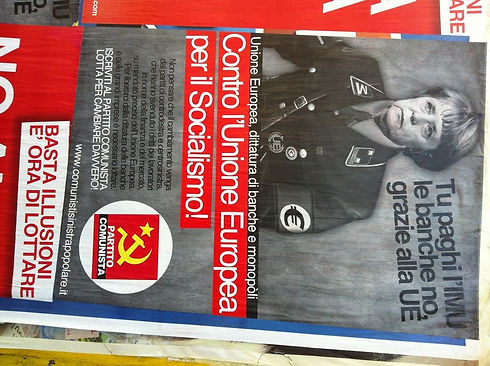
Fact
EU leaders such as Angela Merkel continue to receive the Coudenhove-Kalergi European prize, which was inspired by Count Richard von Coudenhove-Kalergi’s theories.
Richard Nikolaus Eijiro, Count of Coudenhove-Kalergi was an Austrian-Japanese politician, philosopher and Count of Coudenhove-Kalergi. A pioneer of European integration, he served as the founding president of the Paneuropean Union for 49 years.
Richard Coudenhove-Kalergi wrote in ‘Praktischer Idealismus’ (1925): “We intend to turn Europe into a mixed race of Asians and Negros ruled over by the Jews”.
Thomas P.M. Barnett, director of the Israeli military consultancy ‘Wikistrat’ reveiled in his book ‘The Pentagon’s New Map’ (2004): “The ultimate goal is the forcible-coordination of all countries of the world: That shall be achieved by mixing the races with the goal to create a light brown race in Europe. For that reason 1.5 million immigrants from the third world shall migrate to Europe every year. The result would be a population with an average IQ of 90 that is so dumb to grasp anything but intelligent enough to work. The European countries would never again be competitors in the struggle for global domination and a multiple millennia old culture would be destroyed. Irrational people who will fight against this “mingling of races”, and put up any resistance against the global world order, should be killed.”
Census shows that all of Europe and white countries in general will have a majority non-native population within decades. The UN even admits to the replacement of the native populations, calling it replacement migration.
Even the Dalai Lama said that Europe belongs to the Europeans and that we are letting in too many foreigners.
A few examples of what is happening:
Molenbeek, Belgium, is about 85 % Muslim. The place is a shithole.
In St. Denis, Paris, there are 300'000 non-French, mostly Muslims. The place is a shithole.
In Birmingham and London, the native British are in the minority. Savile, a town in Yorkshire has 99 % Muslims.
In primary schools and up to the age of 12, all across Europe, also in Switzerland, the natives are in the minority.
Schools are abolishing anything to do with Christmas because "it could offend Muslims".
A low birth rate amongst the host population, immigration and state-enforced multiculturalism and high birth rates amongst immigrants is demographic suicide or even slow and very painful genocide because according to the UN definition of genocide: either you kill an ethnic group or you distort its foundations of life, which will happen in our children's lifetimes if we do not stop this.
In Europe, we have forced immigration in all and only white countries, forced integration into all white living spaces and forced assimilation promoting "multiculturalism" day and night in all mass media. Nowhere else in the world is that allowed.
In Europe, we have forced immigration in all and only white countries, forced integration into all white living spaces and forced assimilation promoting miscegenation day and night in all mass media, which is factually to an enormous extent owned and run by Zionist Jews.
Jewish EU ‘founding father’ Richard Coudenhove-Kalergi wrote in ‘Praktischer Idealismus’ (1925): “We [Jews] intend to turn Europe into a mixed race of Asians and Negros ruled over by the Jews”.
Thomas P.M. Barnett, a Jew and director of the Israeli military consultancy ‘Wikistrat’ reveiled in his book ‘The Pentagon’s New Map’ (2004): “The ultimate goal is the forcible-coordination of all countries of the world: That shall be achieved by mixing the races with the goal to create a light brown race in Europe. For that reason 1.5 million immigrants from the third world shall migrate to Europe every year. The result would be a population with an average IQ of 90 that is so dumb to grasp anything but intelligent enough to work. The European countries would never again be competitors in the struggle for global domination and a multiple millennia old culture would be destroyed. Irrational people who will fight against this “mingling of races”, and put up any resistance against the global world order, should be killed.”
In Century Magazine, the Jew Marcus Eli Ravage wrote: "We are intruders. We are subverters. We have taken your natural world, your ideals, your destiny, and played havoc with them. We have been at the bottom not merely of the latest great war but of nearly all your wars and revolutions in your history. We have brought discord and confusion and frustration into your personal life. We are still doing it. No one can tell how long we shall go on doing it. Who knows what great and glorious destiny might have been yours if we had left you alone.”
Israel Cohen, wrote: “We must realize that our party’s most powerful weapon is racial tensions. By propounding into the consciousness of the dark races that for centuries they have been oppressed by whites, we can mold them to the program of the Communist Party. In America we will aim for subtle victory. While inflaming the Negro minority against the whites, we will endeavor to instill in the whites a guilt complex for their exploitation of the Negros. We will aid the Negroes to rise in prominence in every walk of life, in the professions and in the world of sports and entertainment. With this prestige, the Negro will be able to intermarry with the whites and begin a process which will deliver America (and the world) to our cause.”
Our culture is being attacked from various angles. Nearly every advertisement in the mass media has some sort of mixed couple in it. White men are made to look weak, nerdy and boring and especially black men are made to look strong, masculine, “cool” and heroic. A group of black or Asian people is considered diverse, a group of white people not. The Western governments enforce the mingling of races: companies are not allowed to only have white staff. If a group of black or Asian people open a store and only employ individuals of their own race or all races excluding whites, it is allowed. If a white organisation does that it is taken to court. Educational and other institutions also discriminate against white people: people of other races are more easily accepted to schools, universities and so on through enforced quotas, encouraging individuals with non-white genes with inferior marks to white people with much higher ones, lowering the likelihood of quality of education and the capabilities of those educated. In anti-white propaganda, there are weaponized words such as “racist!”. The word racist is used to shut people up, to discourage debate and to stigmatize. Words are used to set off triggers. If you have phenomenon in propaganda, it is psychological warfare, which comes down to “you are with us or against us”. When a black person says that he is proud to be black, it is encouraged. When a white person says that, it is considered racist. This double standard and discrimination against white people is very obvious. The word “racist” is used as a weapon to silence the opposition. Racism is a code-word for anti-whiteness.
They do not tell you at school that 1.25 million Europeans were enslaved by Muslims, that mainly the British Empire, so native Europeans, abolished slavery, that the freed slaves who went back to Liberia immediately enslaved the native opulation,
The UN says the future of humanity is African. What could possibly go wrong having races of a continent which was not at all far away from the stone ages only a bit more than a few decades ago before the white man set up a proper civilization there dominate the world in numbers? A hint could be the treatment of white people in South Africa, where government officials are openly calling for the genocide of whites, white farmer families have their land forcefully taken away without compensation and are frequently tortured, raped and murdered. Another one could be what happened to Rhodesia/Zimbabwe, where when blacks took over from whites as the leaders of the country, whites were discriminated against and the whole society basically went up in flames. The economy was destroyed because land was forcefully taken away from white farmers and the new black owners did not know how to do agriculture.
UN data shows that the African population is rising from 200 million in 1950 to a projected 4.2 billion in 2100, an increase of 2000 %. The projections foresee that the world’s population will be about 40 % African and half of the world’s children African by the end of this century, which is probably why China is taking over Africa. The world right now has more than 60 million people who would want to get to the West. Relocating these people geographically to every white country will not help anybody and our peoples and culture will never survive it.
Is it true what people say that immigration will lead to a decrease in poverty world-wide? Definitely not: we take in millions of legal immigrants every year and the vast majority of the world’s population, according to the World Bank, makes less than 2 US dollars a day. There are about 5.6 billion people who are desperately poor and every year, we take in millions and suggest we have somehow made a humanitarian difference. The elites, the globalists, tell us that by taking these millions of immigrants we are somehow tackling world poverty, regardless of the effects on unemployment, the working poor, our culture and genetics, our natural resources and societal systems. Even if we insanely increased immigration, as the unelected bureaucrats in Brussels and others are demanding, it would totally overwhelm our physical, natural and social infrastructures: we could not make a noticeable difference. We may even be hurting the poor by allowing a paradise for people of the third world and increasing the chances of migration, fleeing their countries for a better life, often young men leaving behind children and their whole families. The true heroes of humanitarian issues are people who stay in their countries and become agents for change. Let us help those people in those impoverished countries, but stop this insane flow of migrants. Immigration can never be an effective way of helping people and their countries to get out of poverty.
Arab countries will still be full of Arabs, Africa will be African, Asia Asian, but we Europeans and white countries in general are just supposed to accept the destruction of our millenia-old civilisation, roll over and die out?
The establishment is promoting abortion, divorce, feminism, homosexuality, hookup culture and miscegenation to lower the birth rates of white Europeans.
Through the creation of the EU and the UN, the genocidal plans of people such as Richard Coudenhove-Kalergi, Theodore Newman Kaufman and Earnest Hooton became much closer to reality for Europe. The Western world has undergone unprecedented attacks on demographics, which will very soon lead to the indigenous populations of Europe to become a minority in their homelands. For the first time in the history of the United Kingdom, the White British have already become a minority in London and Birmingham, the two largest cities. By 2050, the indigenous white British will become a minority in Great Britain. All over Europe and white countries in general, the native whites are generally already a minority within the new generations. The U.S. government has released data suggesting that white Americans will be in a minority by 2042. It has scientifically been predicted that ethnic Norwegians will be in a minority in their country within about 20 years. 70 % of pupils in California are Hispanic. All over Europe and in white countries in general, predominantly non-white areas, where everything in those communities is radically changed to the level and ideas of third world-countries, are emerging and rapidly increasing in size.
The most popular boys' name in the United Kingdom and Belgium and probably other places is now Mohamed, the absolute hero of the Muslims, a pedophile and mass murderer.
Through the immigration law of 1965, a group of Jews including Jacob Javits, Emanuel Celler, Leo Pfeffer (former president of American Jewish Congress), Norman Podhoretz (writer and member of the Council of Foreign Relations), decided that America would open its borders and become a “melting pot”. Ten years later, the Zionist Jews David Schwartz and Inga Gottfarb would do the same with Sweden. With a population of about 10 million, Sweden is home to only about 20’000 Jews, being just 0.2 % of the population, who own a vast majority of the Anti-Swedish media through the Bonnier family. These Jewish media moguls have openly said that they plan to “combat whiteness in Sweden” and intend to “exterminate the white race”.
In order for a culture or civilisation to maintain itself for more than 25 years, the required average fertility rate has to be at 2.11, which means that many children per family. A rate of 1.9 has never been reversed and one at is impossible to reverse. If nothing happens, Europe will be Muslim within a few decades.
There are no-go zones and Sharia courts in them, all over Europe. The governments are doing nothing, even labelling people who oppose this insanity as Nazis.
The Muslims usually have a lot more children per couple; Muslim men also often have several wives so some are having dozens of children per one man. Furthermore, when the average European woman has children in her 30s or 40s, Muslim women tend to get their children when they are much younger. As the demographics grow, immigrants demand more and more, they push, we submit: let’s stop this. Stand up and say “this is not going to happen here”.
The EU should undermine national homogeneity, says the UN’s immigration chief Peter Sutherland. The rabbi Baruch Edmati, Jewish school head in the West Bank, said that the Islamization of Europe was a good thing and that “there shall be no remnants and survivors from the impurity of Christianity”.
Merkel, Macron, Cameron, Sarkozy and others have said that diversity and multiculturalism have failed. This is because it would be unnatural for it to work.
Merkel, Macron, Cameron, Sarkozy, the unelected EU bureaucrats and people such as George Soros should be in prison for life.
Erdogan, the Turkish tyrant, demanded in a speech in Germany that his fellow „Muslim brothers“ have even more children because the future of Europe would be Islamic.
All around Europe people are being persecuted for “offensive” expressions of the migration issue. In the UK, the government is planning to hand out up to 15-year jail sentences just for “thought crimes”, so having an opinion, or just viewing right-wing, basically any information with facts, but nothing shall be done about violence and general immorality and hypocrisy of left-wing and violent extremist groups such as Antifa.
Since allowing mass immigration from the third world, crimes have increased drastically. In Sweden, for example, one in four women will be raped, an increase of 500 % in sexual assaults. Malmö, is now the ”rape capital” of Europe, there are hardly any Swedes in Rosengard, and apart from South Africa, the “rape capital”of the world. Official police records, calling it a rape epidemic before they were silenced, showed that 100 % of rapes in Oslo were committed by non-white immigrants and that nine of ten victims were native Norwegian women. Police departments all around Europe have confirmed that the increase in crime and the level of violence is absolutely shocking but they are often no longer allowed to speak about it, they don’t touch predominantly non-white areas while “Sharia patrol”-units of Muslims are patrolling around and harassing all those they deem going against their 6th-century ideology in any way. In Muslim countries, it is usual for women who were raped to be stoned to death, hands to be cut off for stealing bread and most Muslims want Sharia law in Europe because their religion tells them that that is what is to be done according to the Koran, yet Feminists very rarely talk about Islam, which does not make sense if they believe in equality for women. The UK police even protected child grooming gangs, from Muslims to top-level politicians, businessmen or other important and rich members of society and the UK prisons have been taken over by extremist Muslims, the breeding grounds for Islamic radicalism.
Coudenhove-Kalergi, founding father of the EU, published the plan for a united Europe and the ethnocide of the people of Europe. The encouragement of mass non-white immigration was central to the plot. An unholy alliance of elitists, globalists, leftists, cultural Marxists (communists), bought capitalists, Zionist Supremacists and Muslim extremists, amongst others such as Satanists, feminists and, in general, anti-white- and anti-Christian advocates has schemed to promote immigration and miscegenation with the deliberate aim of breeding us, the white race, out of existence in our own homelands. As indigenous resistance to these human genetic modification industry is growing, the criminal elite seek to new ways to camouflage their project: first immigration started with "temporary guest workers", then it was a "multiracial experiment", then they were refugees, then an answer to a shrinking population, then asylum seekers: one excuse after the next. Different excuses, different lies.
The real goal stays the same: the biggest genocide in human history, the answer to the final solution to the “European Christian problem”. This crime demands a new set of Nuremburg trials and those responsible will be in the dock.
Vladimir Putin had this to say:
“We see many of the Euro-Atlantic countries are actually rejecting their roots, including the Christian values that constitute the basis of Western civilisation. They are denying moral principles and all traditional identities: national, cultural, religious and even sexual. They are implementing policies that equate large families with same-sex partnerships, belief in God with the belief in Satan.
The excesses of political correctness have reached the point where people are seriously talking about registering political parties whose aim is to promote paedophilia.
People in many European countries are embarrassed or afraid to talk about their religious affiliations. Holidays are abolished or even called something different; their essence is hidden away, as is their moral foundation. And people are aggressively trying to export this model all over the world. I am convinced that this opens a direct path to degradation and primitivism, resulting in a profound demographic and moral crisis.
We see attempts to somehow revive a standardised model of a unipolar world and to blur the institutions of international law and national sovereignty. Such a unipolar, standardised world does not require sovereign states; it requires vassals. In a historical sense this amounts to a rejection of one’s own identity, of the God-given diversity of the world.”
The birth rate of immigrants does adapt, at least a bit, to that of the host population. But as there are still millions of people who arrive in Europe every year who at first, at least, live their culture and want to preserve it, so the newly arrived keep fucking like rabbits. So they still have lots of babies, more than the native population. Scientific estimates predict a future in the relative short-term, and very quickly in terms of history, where actually, the native Europeans race will only continue as genes included into the overwhelming, mostly Arab and African genes of immigrants.
And if "the best" are sent here to get money for their families, they are a) economic migrants b) parasites of European countries c) as "the best" are out of their countries, it is harder for development in these countries.
Through my work, we do not send them money at first. At first, they have to show that they are actually doing something and have plans. It nearly always fails. Through my work, I have had to do with a lot of ministers from Africa. They are incapable, to say the least. Africa was very to the stone ages before the Arabs and white men went there.
In Switzerland there are more foreigners than the entirety of number of inhabitants of the Romandie. In Switzerland, we have more economic migrants from Eritrea than their are inhabitants of the Canton of Appenzell. The migrant and asylum seekers’ industry is a billion-Franc-industry. The people have to pay for it.
The salaries of the Swiss are decreasing yearly by 2 per cent, whilst the costs for the taxpayer are getting higher. In 74 % of crimes in Switzerland, foreigners are involved. The vast majority of the rest are commited by new Swiss citizens, so basically foreigners. Look at the prisons. Switzerland has 38.2 % or five-times more foreigners than for example Denmark. Only Luxembourg has a higher percentage of foreigners. In Switzerland, more foreigners get Swiss citizenship every year than the city of Thun or Shaffhausen has inhabitants, whether they have a criminal record, speak one of our languages, are integrated or not.
An official study has shown that at the latest in the year 2090, Europe will be Muslim.

